
Why Motorists Need a Solar Panel Battery Maintainer
 By Ray Barnes
 A solar panel battery maintainer is one of the cheapest and most effective ways to protect your car battery from the damage caused by sitting unused. Ray explains why they matter, how they work, and who needs one.
The most common reason I get called out day in, day out isn't a faulty battery or a failing alternator. It's a perfectly good battery that's gone flat because the car hasn't been driven.
Modern vehicles draw a small but constant current even when parked from the alarm system, the ECU, the clock, and various other standby systems. Leave a car sitting for two or three weeks without driving it, and that drain can be enough to leave you stranded.
A solar panel battery maintainer is one of the simplest and most cost-effective ways to prevent this from happening. I recommend them to almost every customer I attend particularly those with second cars, classic vehicles, vans that sit over weekends, or anyone who travels regularly and leaves their car parked for extended periods.
What Is a Solar Panel Battery Maintainer?
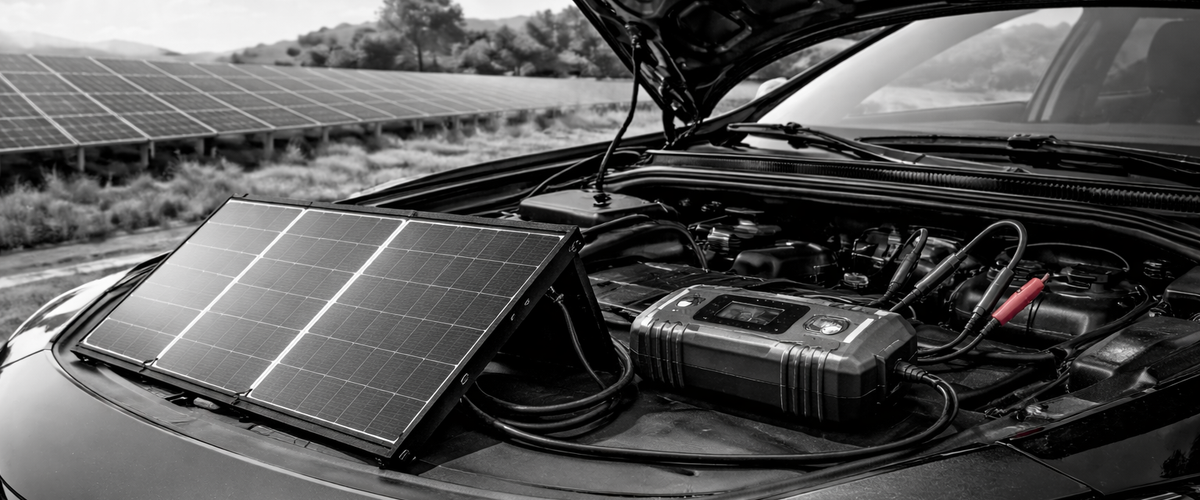
A solar panel battery maintainer, sometimes called a trickle charger or solar trickle charger is a small photovoltaic panel, typically between 1.5W and 10W, that sits on your dashboard or windscreen and uses daylight to feed a gentle, continuous charge into your battery.
It isn't designed to charge a fully flat battery quickly. That's not what it's for. Its purpose is to offset the natural self-discharge of the battery and the parasitic drain from the vehicle's standby systems, keeping the battery at or near full charge indefinitely, without any intervention from you.
Most units connect directly to the battery via crocodile clips or through the 12V accessory socket, and require no installation, no specialist knowledge, and no ongoing maintenance. You put it on the dashboard, plug it in, and forget about it.
Why Car Batteries Go Flat Without Being Driven
To understand why a solar maintainer is useful, it helps to understand what's happening to your battery when the car is parked.
A modern car has dozens of electronic systems that draw current even when the ignition is off. Your alarm, your central locking module, your ECU, your infotainment system memory, your clock, all of these draw small amounts of current continuously.
This is called parasitic drain, and it's completely normal. In a healthy vehicle it's usually between 20 and 50 milliamps. At that rate, a fully charged 60Ah battery can theoretically last around 50 days before dropping to a level where the car won't start.
In practice, the number is lower because batteries lose efficiency with age, because cold temperatures reduce capacity significantly, and because many modern vehicles with more complex electronics draw more than the average. The result is that a car left parked for three to four weeks in winter can easily fail to start not because anything is wrong with it, but simply because the battery ran out of charge.
A solar maintainer running at even 1.5W in reasonable daylight can offset the typical parasitic drain and keep the battery topped up indefinitely.
Who Needs a Solar Panel Battery Maintainer?
In my experience, there are four groups of car owners who benefit most:
Owners of second or occasional-use cars.
If you have a car that sits on the driveway during the week and only gets used at weekends, or a second vehicle that only comes out occasionally, a solar maintainer is essential.
These vehicles account for a disproportionate number of the callouts I attend.
Classic and vintage car owners.
Older vehicles are often stored for months at a time, over winter, during a restoration, or simply because they're driven seasonally. A classic car battery left unattended for three months will almost certainly need a jump start or replacement by spring. A solar maintainer keeps it ready to go.
Van and light commercial owners.
Vans that aren't driven at weekends sit for 60 hours at a time between Friday evening and Monday morning. In cold weather, that's often enough to flatten an older battery. A solar panel on the dashboard costs almost nothing and eliminates the problem entirely.
Anyone who travels frequently for work.
If you regularly take trains, planes, or work away from home and your car sits parked for a week or more at a time, a solar maintainer is worth having. The cost of one callout, or one replacement battery is many times the cost of the device.
How Much Daylight Does a Solar Maintainer Actually Need?
This is the question I get asked most often. The answer is less than most people assume. A 2.5W solar panel in typical UK daylight, even overcast UK daylight can generate enough current to offset the parasitic drain on most standard vehicles.
It doesn't need direct sunlight. Diffuse light through cloud cover is sufficient for a maintenance charge, though it won't generate as much current as direct sun.
The key is positioning.
The panel needs to be on the dashboard facing upward toward the windscreen, or fixed to the exterior of the vehicle in a position where it receives reasonable sky exposure. A panel tucked under a seat or covered by a bag won't do anything useful.
In winter months, shorter days reduce the available charge time, but even a few hours of daylight at low intensity is usually enough to maintain a healthy battery in a vehicle with normal parasitic drain.
What to Look for When Buying One
You don't need to spend a lot of money. A quality solar battery maintainer costs between £15 and £50 and will last for years. Here's what matters:
Wattage.
For a standard passenger car with normal parasitic drain, 2.5W to 5W is sufficient for maintenance purposes. If you have a vehicle with higher draw, a campervan, a vehicle with an aftermarket alarm, or anything with a lot of standby electronics, aim for 5W to 10W.
Built-in protection.
Look for a unit with a blocking diode or charge controller. Without this, the panel can actually draw current back out of the battery at night, the opposite of what you want. Most reputable units include this protection, but it's worth checking.
Connection type.
Most panels come with crocodile clips for direct battery connection and a 12V plug for the accessory socket. The battery connection is more reliable and gives a direct charge, the accessory socket connection only works if your vehicle keeps the socket live with the ignition off, which not all do.
Quality of construction.
The panel will sit on your dashboard and be exposed to sunlight daily. A poorly made unit will degrade quickly. Branded units from established manufacturers are worth the modest premium.
What a Solar Maintainer Won't Do
It's important to be clear about the limitations. A solar maintainer will not charge a battery that is already flat. If your battery has discharged to the point where the car won't start, you need a jump start or a mains-powered battery charger not a solar panel.
The wattage is too low to recover a deeply discharged battery in any useful timeframe. It will also not compensate for a failing battery.
If your battery has degraded to the point where it can no longer hold a charge typically after four to five years, a maintainer will slow the decline but won't fix the underlying problem.
If your car is struggling to start even after being maintained, the battery likely needs replacing. And it won't fix an alternator fault. If your alternator isn't charging the battery while the engine runs, the battery will continue to discharge regardless of what maintainer you have.
If your battery keeps going flat even when you're driving regularly, get the charging system tested.
The Bottom Line
A solar panel battery maintainer is not a cure-all. But for the specific problem it solves, battery discharge caused by sitting unused it is remarkably effective for the cost.
If you have a second car, a classic, a van, or you travel regularly and leave your car sitting buy one. It costs less than a callout. If you do find yourself with a flat battery that a solar maintainer can't fix.
Our Services

Ray Recommends
ECO-WORTHY 10W Solar Battery Trickle Charger & Maintainer
A simple, no-fuss solar maintainer that keeps a 12V battery topped up while the vehicle is parked. No wiring, no subscription, no ongoing cost. Not a battery charger a maintainer. Know the difference before you buy.
View full reviewFrequently Asked Questions
Will a solar panel battery maintainer work in cloudy UK weather?
Yes a solar maintainer doesn't need direct sunlight, just daylight. Diffuse light through cloud cover is sufficient to generate a maintenance charge, though output will be lower than in direct sun. Even a few hours of overcast daylight is usually enough to offset normal parasitic drain.
Can I leave a solar battery maintainer connected all the time?
Yes, provided the unit has a built-in blocking diode or charge controller. This prevents the panel from drawing current back out of the battery at night. Most quality units include this check before buying.
What size solar panel do I need for my car?
For a standard passenger car, 2.5W to 5W is sufficient for maintenance purposes. Larger vehicles, campervans, or vehicles with high parasitic drain may benefit from a 5W to 10W panel. You don't need anything larger for a standard maintenance application.
Will a solar maintainer charge a completely flat battery?
No. A solar maintainer is designed to prevent a battery from going flat — not to recover one that already has. If your battery is fully discharged, you need a jump start or a mains-powered charger first, then the solar panel to maintain it going forward.
How long does a car battery last if it keeps going flat from sitting unused?
Every deep discharge cycle permanently reduces a battery's capacity. A battery that is regularly allowed to fully discharge may last only 2–3 years instead of the typical 4–5. Keeping it maintained with a solar charger significantly extends battery life.